
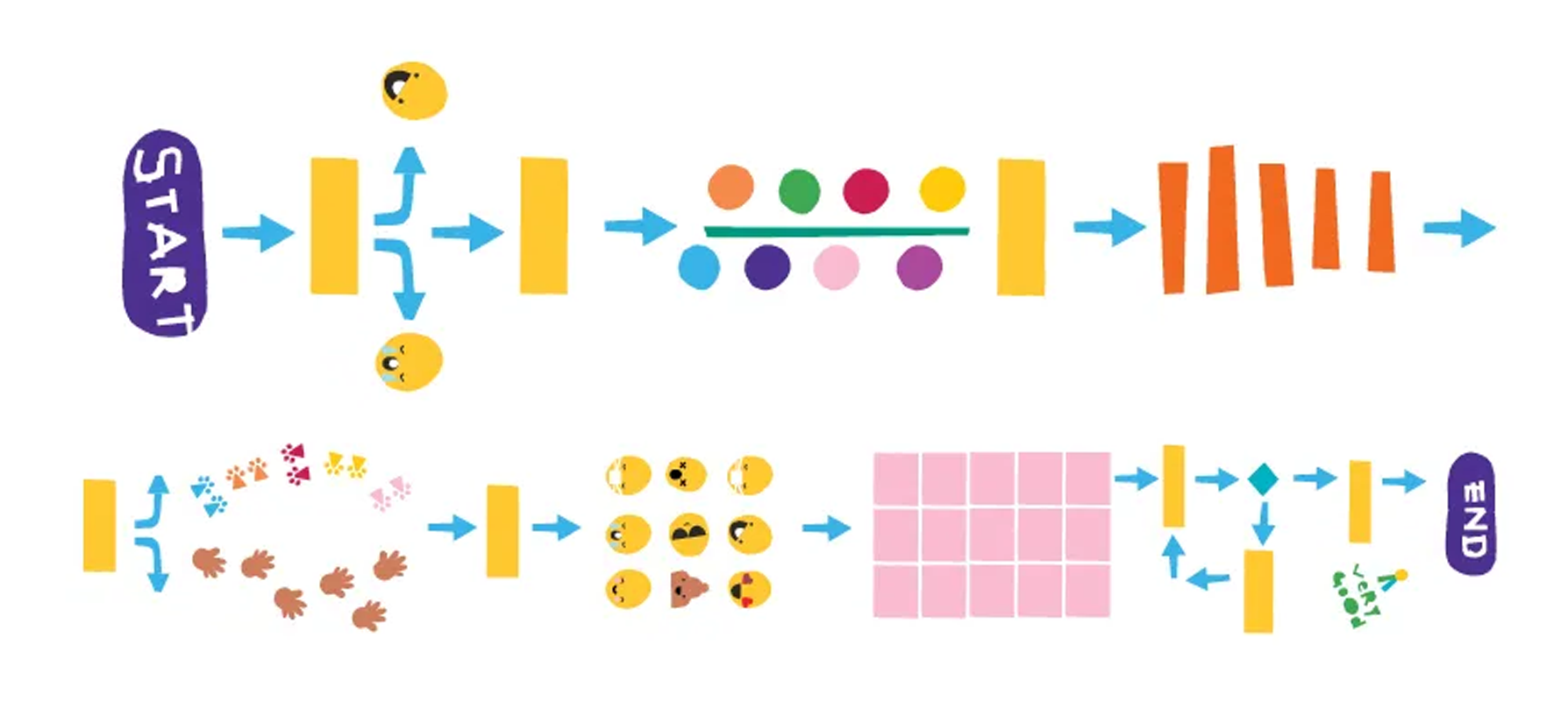

## You’ll need - Chalk (or painter’s tape for indoors) - An open space (asphalt is perfect) - Optional: the printable symbols PDF
## Two ways to build it Choose one: - Chalk version (recommended): draw the symbols straight onto the ground. - Cut-out version: print and cut the symbols, then tape them down. :
## First: look at the symbols Before you start drawing, decide what your “language” can say: - START / END: begin and stop - Arrows: what “next” means - Diamond: a question (a decision) - Branch: two possible paths - Blank boxes: places to write instructions - Footprints / hands / faces: ready-made “clues” for choices
Ask: What can these symbols express? What can’t they express?
## Big-group version This works beautifully with a crowd.
- Draw a big grid on the ground (or mark 6–8 “zones” with chalk).
- Split into small teams. Each team picks one zone.
- Each team designs a short program for moving through their zone:
- a clear START and END for the zone,
- arrows that show the route,
- a few instruction boxes,
- optional: one decision (diamond + two routes).
- Teams take turns teaching their program to everyone else. The rest of the group becomes the “computer” and runs it with their bodies.
- When every team has presented, walk the full track together—zone to zone.
Tip: choose a cozy spot nearby where you tell a short story that belongs to the route. (A quest. A lost mitten. A robot learning manners. A secret shortcut.)
## Small-group version (fast start) 1. Draw START. 2. Add 3–6 steps as arrows + instruction boxes. 3. Add END. 4. Run it once, then switch roles.
## Add one decision Add a diamond question that can be answered right now: - “Am I stepping on a footprint?” - “Is my hand touching the line?” - “Am I smiling?”
Draw two routes: - IF yes → go this way - ELSE → go that way
## Debug (on purpose) Make a tiny mistake, then fix it: - a missing arrow - two arrows that disagree about “next” - a loop that never reaches END - a question nobody can answer
Run → get stuck → change one thing → run again.
## Talk about it - What counted as a “bug” today: the code, or the interpretation? - What was the smallest change that made it work? - Where did the program need a clearer symbol?